Opens May 10, 2025 and Announces Public Program
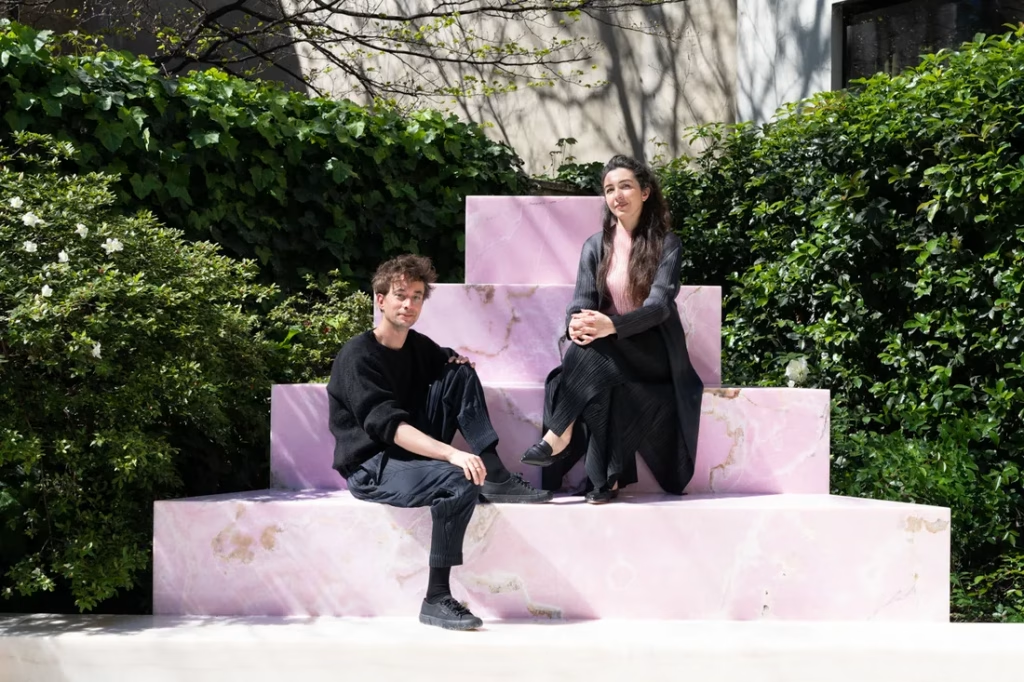
Venice, Italy, May 9, 2025 – The National Pavilion of Saudi Arabia at the Biennale Architettura 2025, titled The Um Slaim School: An Architecture of Connection, opens to the public on May 10, 2025. Presenting the work of Syn Architects (Sara Alissa and Nojoud Alsudairi), curated by Beatrice Leanza with assistant curator Sara Almutlaq. The pavilion showcases the work of the Um Slaim Collective in documenting and researching local Najdi architecture in Riyadh. Taking this as a starting point to explore architecture as a medium of collective learning, it sets a stage for the emergence of new spatial practices that respond to contemporary social and environmental challenges.

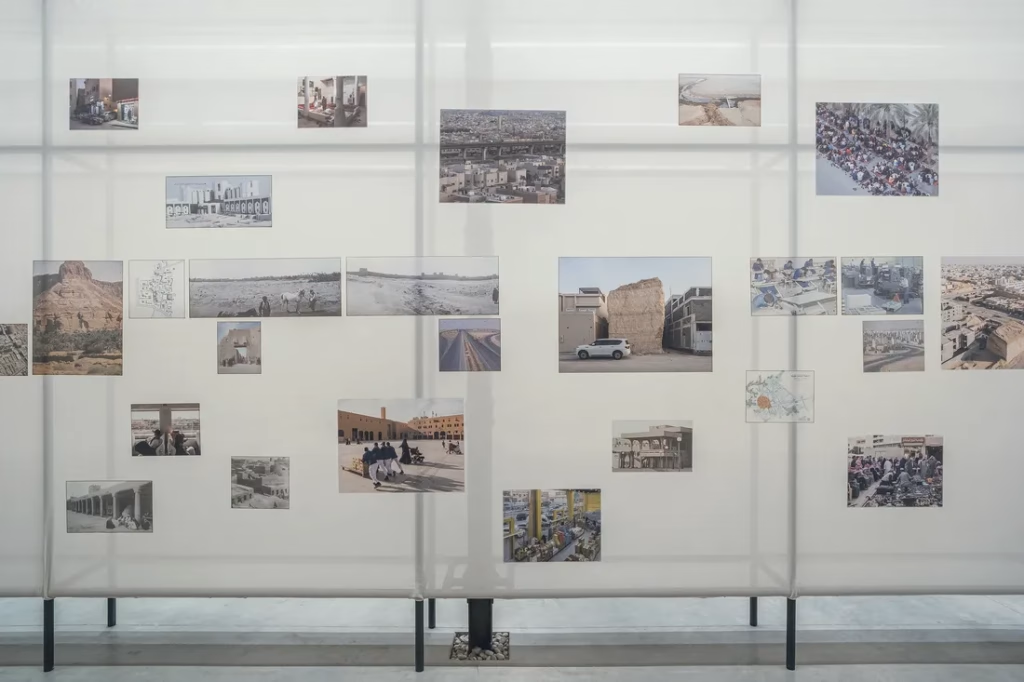
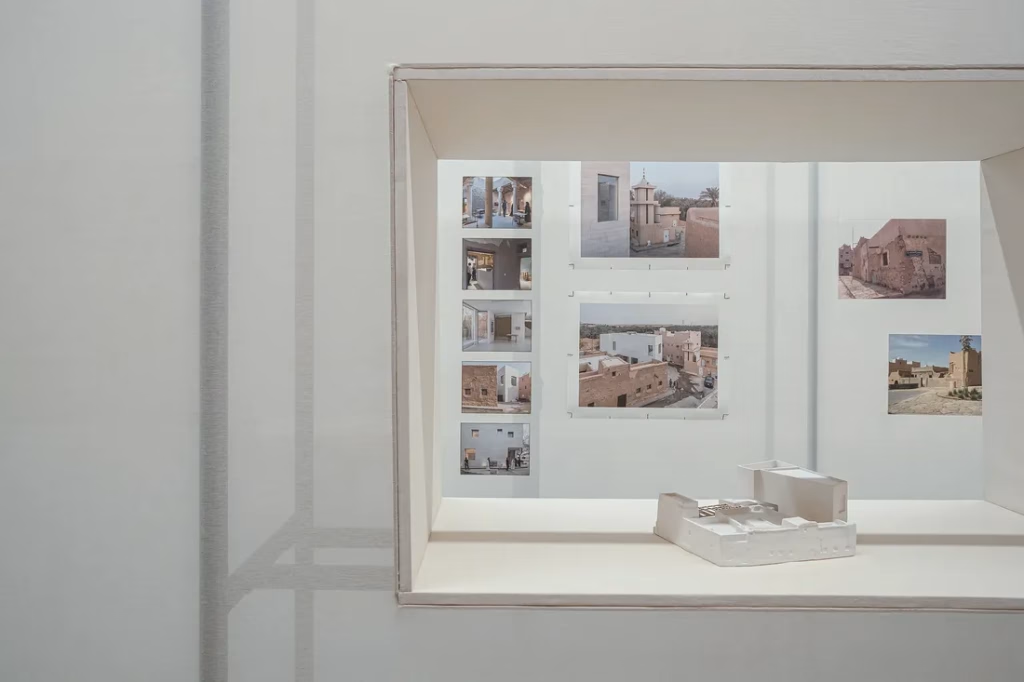
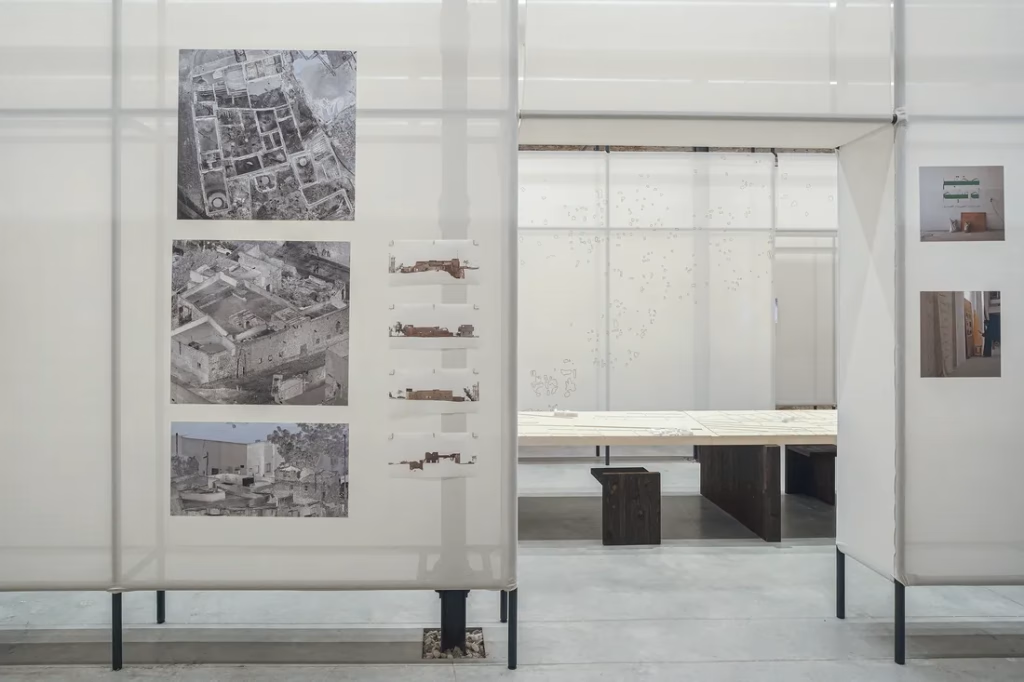
Conceived as a living archive and communal gathering space, the pavilion presents material experiments, archival and contemporary photographs, models, films, and a sonic piece, drawing on the practice and research of Syn Architects, the Um Slaim Collective, and their collaborators. The Collective, operating out of the eponymous Riyadh district, is a vehicle for research and fieldwork on vernacular building methods and the evolution of Najdi architecture. Framing this investigative practice as a means for rethinking urban space, neighborhood communities, and material resources, The Um Slaim School is a framework for future pedagogical activities to be realized in Riyadh post-Biennale, establishing new connections between traditional building practices and urgent questions of today.
The project is constituted of three integral components: the exhibition presented inside the pavilion, a generative public program, titled BUILT/UNBUILT—Relational Pedagogies and Participatory Spatial Practice (or how to build collective spatial knowledge), evolving along the duration of the Biennale, and two publications. The first publication provides a spatial syntax that also guides the pavilion, and the second will serve as a proof of concept for future applications after the Biennale. The focus on collectivity and material expression is translated into the pavilion’s exhibition layout and design: along the central axis of the pavilion a long sculptural table—both an urban map and a gathering place—is sheltered in a “building within a building” made of scaffolding and layered textiles of embroidered maps and drawings interspersed with film, writing, and photography.
The exhibition integrates works by Syn Architects’ long-term collaborators, including three new commissions: Architectural Frequencies (2025), an immersive sound installation by Mohammed Alhamdan (7amdan), serves as the sonic underpinning of the exhibition, layering urban recordings of Riyadh, construction sounds and traditional building chants; Maha Malluh’s Tamwenat Addirah (2025) explores the local identity of the Um Slaim neighbourhood through collected market items; and photographer Laurian Ghinițoiu’s present tense (2023–25) documents neighborhoods of central Riyadh, including ritualized rhythms of daily life. Alongside these, photography by Mansour Alsofi documents modernist and postmodernist buildings in the city, and historical photographs and archival books trace the city’s urban and architectural evolution.
Running concurrently with the exhibition is the public program BUILT/UNBUILT—Relational Pedagogies and Participatory Spatial Practice (or how to build collective spatial knowledge). Curated by Beatrice Leanza and co-led by Maryam AlNoaimi, the program is an extension of the pavilion that aims to foster critical discourse and collaborative inquiry into the role of architecture in shaping education and socially engaged practices. It consists of a series of public events comprised of lectures, workshops, performances, screenings, readings, and walks.
The program’s public sessions are hosted at Palazzo Diedo—Berggruen Arts & Culture from June to November and are free to attend upon registration. Three thematic labs are developed in collaboration with Bricklab (Abdulrahman and Turki Gazzaz), Studio Ossidiana (Alessandra Covini, Giovanni Bellotti), and the Institute for Postnatural Studies (Gabriel Alonso, Yuri Tuma, Daniel H. Rey). These collaborators, alongside an international group of invited contributors, Syn Architects, and The Um Slaim School’s curatorial team, will accompany participants in sessions exploring public archives, material heritage, alternative education, and participatory spatial practice. The ideas and practical outcomes generated during the entirety of the program will be collated in a publication launched in the fall of 2025.
Dr. Sumayah Al-Solaiman, Chief Executive Officer of the Architecture and Design Commission, Ministry of Culture, Saudi Arabia, said: “The National Pavilion of Saudi Arabia underscores a commitment to fostering cross-cultural dialogue, experimental pedagogy, and transnational collaboration. With The Um Slaim School: An Architecture of Connection, the pavilion presents members of the next generation of architects shaping Saudi Arabia’s future. It welcomes their role in contributing to broader conversations on the evolving role of architecture in contemporary society.”
Sara Alissa and Nojoud Alsudairi, Syn Architects’ partners, said: “We see The Um Slaim School as a new chapter—where architectural knowledge rooted in Riyadh finds wider resonance. Our work engages the urgent challenges embedded within our sites of investigation, with a focus on the local context. Our ambition is for this pavilion to embody a new paradigm for architectural education in Saudi Arabia, one that interweaves historical legacies with contemporary practices. By employing diverse methods of architectural documentation and production, we are creating collective spaces to learn in and learn from. We aspire to shape a vision in which architecture evolves beyond its physical form, becoming a vessel for cultural preservation and a bridge that fosters both regional and global connections.”
Beatrice Leanza, Curator, National Pavilion Saudi Arabia said: “The Um Slaim School investigates how architecture can help rewire stakeholders’ relations among the natural, social, and technological that support virtuous relationships of co-creation and co-dependence. This is realized through a durational program along the Biennale’s months to reevaluate the operational dynamics of architecture and to connect with the current educational landscape, bringing renewed urgency to the civic and impact-driven remit of the practice globally.”
About the National Pavilion of Saudi Arabia
The National Pavilion of Saudi Arabia supports and celebrates the Kingdom’s artistic and architectural community. It serves as a meeting space for dialogue between creative minds, and an exchange of concepts and ideas. The pavilion provides a permanent home for research and ideation from the nation’s leading cultural voices. To learn more about the National Pavilion of Saudi Arabia, please visit www.saudipavilion.org and on Instagram: @saudipavilion.
About Syn Architects
Sara Alissa and Nojoud Alsudairi co-founded Syn Architects in 2018, an interdisciplinary Riyadh-based practice with a focus on ecologically sensitive architectural design. In 2021, they launched the Um Slaim Collective, a critical investigation of the displacement of vernacular Najdi architecture in central Riyadh. They are also the co-founders of SaudiArchitecture.org, an independent organization that aims to research and archive modernist and postmodernist buildings in Saudi Arabia. Architects and artists, they are graduates of the Situated Practice program at The Bartlett School of Architecture, University College London. Their notable projects include When the Earth Began to Look at Itself (2024) at Desert X AlUla, Anywhere Can Be a Place of Worship (2023) at the Islamic Arts Biennale, and the restoration and extension of Shamalat Cultural Center, Riyadh (2023).
About Beatrice Leanza
Beatrice Leanza is a cultural strategist, museum director, and critic with expertise in design and arts across Asia and beyond. She earned an MA in Asian Studies from Ca’ Foscari University, Venice, specializing in contemporary Chinese art, and spent seventeen years in Beijing shaping the Chinese creative scene. Leanza has served as executive director of MAAT – Museum of Art, Architecture, and Technology (Lisbon), director of mudac – Museum of Contemporary Design and Applied Arts (Lausanne), and creative director of Beijing Design Week, where she launched the Baitasi Remade urban regeneration program. She also co-founded The Global School, China’s first independent institute for design and creative practice.
Her international projects include Across Chinese Cities at the Venice Architecture Biennale (2014, 2016, 2018) and Visual Natures at MAAT (2020–2022). A European Young Leader since 2018, she serves on the advisory board of Design Trust (Hong Kong). Her book The New Design Museum (Park Books, 2025) explores institutional practices in design and architecture addressing twenty-first-century challenges.
About the Architecture and Design Commission
The Architecture and Design Commission, established in 2020, is one of eleven commissions under the Ministry of Culture in Saudi Arabia, representing key disciplines including architecture, urban design and planning, landscape architecture, interior design, graphic design, and industrial design. The Commission supports and encourages practitioners, organizes exhibitions and seminars, and stimulates thinking in the sector to build an architecture and design landscape that mirrors the Kingdom’s rich and diverse culture.
Aligned with the objectives of the Ministry of Culture and Vision 2030, the Architecture and Design Commission promotes excellence in architecture and design, reflects Saudi Arabia’s cultural identity and ambitions, empowers local talent, and enhances the quality of life within communities.
About the Ministry of Culture, Kingdom of Saudi Arabia
Saudi Arabia has a vast history of arts and culture. The Ministry of Culture is developing Saudi Arabia’s cultural economy and enriching the daily lives of citizens, residents, and visitors. Overseeing eleven sector-specific commissions, the Ministry is leading a cultural transformation to develop an abundant ecosystem that nurtures creativity, unlocks the economic potential of the sector, and unleashes new and inspiring forms of expression. Find the Ministry of Culture on social media: X (Twitter) @MOCSaudi (Arabic); @MOCSaudi_En (English) | Instagram @mocsaudi.



Discover more from DGN Gate
Subscribe to get the latest posts sent to your email.